Affiliate Disclosure: This post may contain affiliate links. As an Amazon Associate planeview.farm earns from qualifying purchases. This means I may receive a commission if you click on a link and make a purchase, at no extra cost to you. For more information see Terms of Service.
Don’t Buy Cattle!
Beef prices are at an all time high, and I’m not just talking about at the grocery store. Tight supply and steady demand have sent cattle prices at the sale barn soaring. In fact, prices are up about 18% over where they were just one year ago. Market analysts are saying that high prices aren’t likely to change because there’s been little, if any, improvement in the national herd size.
But, I’m here to tell you that even with all of that seemingly good news for the cattle market, the best investment, especially for new farmers, is not cattle, but sheep and goats.
In this post, I’m going to tell you why, dollar for dollar, sheep and goats continue to deliver the best bang for your buck.

Entry Costs: The Sheep and Goat Market Requires Less Money to Get Started.
Initial Purchase Prices:
If you’re looking to get started in the cattle business, you’re likely going to have to come up with $2,500 to $4,000 per head for a good quality beef cow that is either in her prime productive years or just coming into those prime productive years.
On the other hand, a good quality ewe can be had for $220 to $375, with ewes on the higher end of the scale likely coming to you already bred.
The same is true for goats. A good quality doe can be purchased for the same price, also bred.
The rule of thumb I’ve always heard is that it takes six or seven sheep or goats to equal one cow. That means that you can purchase the equivalent of one cow for $1,320 to $2,625.
Fencing and Infrastructure Requirements:
While it’s true that you’ll need a better fence to keep sheep and goats in, than you will for cattle, it’s not as expensive as some might lead you to believe.
If you prefer barbed wire fence, adding a couple more strands between your bottom two wires is enough for many to keep sheep and goats where they’re supposed to be.
If you’re like me, and you prefer electric fence, you can build a seven-strand high tensile electric fence that will keep even the orneriest animal on the farm cheaper than a five-strand barbed wire fence that is common for cattle.

If I were to build the same high tensile electric perimeter fence that I have on my farm today, it would cost me between 70 and 80 cents per foot, if I do it myself. That is far cheaper than the sheep and goat woven wire fence that so many will tell you that you need to keep them in.
I’ve never had a problem with the fence that I have, and this is the second property I’ve used this style of fence on to keep my goats where they belong.
So, the point here is, don’t let anyone tell you that it’s cost prohibitive to fence in sheep and goats compared to cattle because it’s just not true. The only difference is that the cows require two fewer strands of wire. As of the date of this post, the cost of 12.5 gauge high tensile wire at my local farm store is only about 4 cents per foot.
Handling Equipment and Facilities:
Naturally, with sheep and goats being much smaller than cattle, you don’t have to have heavy duty handling equipment and facilities in order to work your livestock.
In fact, I don’t have any specialized goat handling equipment even though I’ve been raising Boer meat goats for over 10 years. In that time I’ve simply bunched them up into a small space and caught them by hand and worked them one by one.
I’ve never been able to grab ahold of one of my grown cattle, even though they’re Lowlines, and work them.
But, even if you would prefer to have working equipment, a nice squeeze chute that rotates for foot care can be had for $1,500 to $3,000, depending on how fancy you want to go.
Cattle squeeze chutes start at $2,500 on the low end of the scale. These price differences are the same for panels and other working equipment as well.
Feed Requirements:
Sheep and goats convert feed to meat at nearly twice the rate of cattle. Sheep and goats need 4 to 6 lbs. of feed to produce a pound of meat where cattle require 6 to 10 lbs. of feed to produce a pound of meat.
One major difference between sheep and goats when compared to cattle is that cattle require high quality grass forage if they are going to be finished on grass alone. Sheep can easily be finished solely on grass forage that is on the low to moderate end of the quality scale.
When it comes to goats, weeds and brush are your friend. I was speaking to a very highly respected goat breeder a few years ago who laughed as he said that while cattle farmers all over southern Missouri are spraying herbicide on the Sericea Lespedeza growing in their pastures, he’s trying to keep his goats from over grazing it and killing it out.
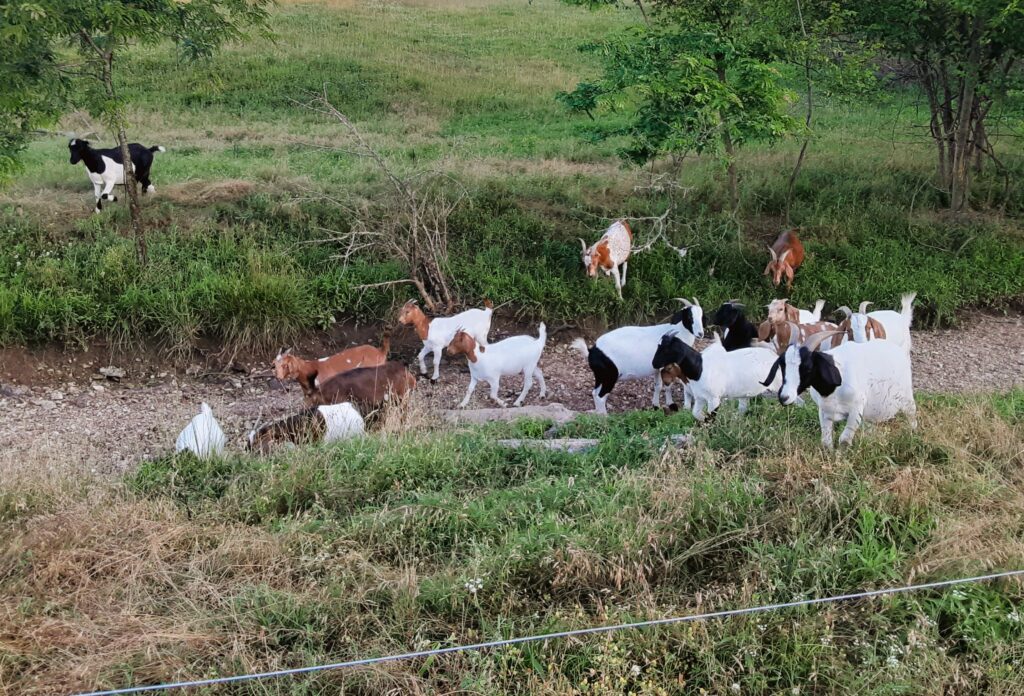
I’ve heard some producers say that they can overwinter their sheep and goats for roughly $10 to $25 per head while cattle can range from $100 to $250 per head based on where you live. It would take 10 sheep or goats to equal the cost of 1 cow. If you remember, the rule of thumb is that it takes 6 or 7 sheep or goats to make one cow equivalent.
Labor Requirements:
One of the most frequent arguments I hear in favor of cattle over sheep and goats is that cattle require much less labor. Instead of caring for 6 or 7 animals, you only have to care for 1. While that is true, just as I mentioned before, the size difference makes up for the increased number of animals, at least in some folks’ opinion. A friend of mine recently told me that since he’s made the switch from cattle to sheep, he’s not had to worry about getting knocked off his feet or run over when he’s working his livestock.
Now, I will admit that during lambing or kidding season, you must pay closer attention to your animals because newborn lambs and kids can be fragile, especially during harsh weather conditions. You can add to this the threat of predation.
Of course, while they may not require the same close monitoring that sheep and goats do, cattle are definitely not immune from trouble during calving season.
The reality is that if you’re using a management intensive system for whatever livestock you’re raising, you’re probably going to be paying close attention to what is going on with them on a daily basis anyway.

Market Stability: The Cattle Market Has a History of Volatility:
When I was a kid in the late 1980’s and early 90’s, my parents were buying cattle to stock an 80-acre farm they had purchased along with property they were renting. Then, in the mid 90’s, record high inventories coupled with a drought led to a market crash that saw cattle prices fall by half in some parts of the country.
My parents suddenly found themselves with a lot of cattle that were suddenly worth less than what they had paid just a few short years before.
Then, as the market recovered in the early 2000’s, a near 30% drop hit the market in 2008, followed by a major drought in 2010 and 2011. It was at this point that many farms began to sell off complete herds because they had nothing to feed their animals.
A strong recovery followed because of strong demand and decreased inventory. Does that sound familiar. Many farmers who’d sold out in 2011 at the bottom of the market bought back in at the top only to see a market correction in the years leading up to the COVID pandemic.

In these years since the pandemic, we’ve seen record cattle prices driven by high demand and low inventory. 9 or 10 years ago you could buy a young, bred cow for $1,500. As I mentioned before, that same animal is likely to bring between $2,500 to $4,000 today.
The concerning part of this is that there are many young farmers who are just starting out, mortgaging their futures on a market that will eventually correct.
I’m not going to pretend to tell you when that will be, but with more people looking to get into the cattle market, there will be fewer and fewer heifers going to slaughter as more are bought as breeding stock. Inventory numbers will suddenly increase are those heifers become productive.
Then, the market will hit a turning point and the bubble will burst, just as it always has.
I’m not going to tell you that the sheep and goat market is immune to fluctuation, in fact it has seen some volatility as well, but the major difference is the built in productivity advantage of small ruminants.
Profitability and ROI: Returns Favor Small Ruminants:
Dollar for Dollar Comparison:
At the end of the day, farmers are just another form of investors. They are investing capital in a market, hoping for a return on their money. If you had $30k to invest in livestock, should you invest in cattle or sheep/goats? Let’s make a comparison and find out:
10 good cows for $30k vs. 100 good ewes for $30K
- From conception to market, it will take at least 15 months to have a calf reach a market weight of 500lbs.
- From conception to market, it will take 8 months to have a lamb reach a market weight of 60 lbs.
- Say that you have 10 calves, or 5000lbs of calves to sell at 15 months compared to 150 lambs (assuming a lambing rate of 1.5), or 9000lbs of lambs at 8 months.
- The most recent market report from my local market, as of the making of this post shows 500 weight number 1 steers selling for $5.05/lb. That number gives us a total of $25,250 in gross revenue from those 10 cows.
- The most recent sheep and goat report from my local market shows 60lb hair breed lambs selling for an average $4.03/lb.
- That gives us a total of $36,270 in gross revenue from those 100 ewes.
Generally speaking, the break even timeline for cattle is 3 or 4 years compared to 18 to 24 months for sheep and goats.
As I said, the sheep and goats have a build in advantage in terms of productivity that drastically reduces the risk in that market. A lot can happen in a cattle market in 3 or 4 years.
Another major benefit to sheep and goats is that you can implement an accelerated breeding program that will allow you to kid or lamb every 8 months instead of annually. So, in the event of a major market adjustment, you have something to fall back on.

Final Thoughts:
I want you to understand that I have absolutely nothing against cattle. I have cattle, I’ve always been around them, and they’re probably my favorite farm animal. There’s just something about them that I’ve always loved.
However, that doesn’t mean I’m willing to overlook the reality of the current market. If you are just starting out and you love cattle and can’t see yourself raising anything else, understand that there’s a risk to entering that market. I honestly wish you all the success in the world, but I’m not willing to take that risk myself!
It’s also worth noting that even at a point when the cattle market is soaring to heights never seen before, from a purely financial point of view, small ruminants are still the better investment.